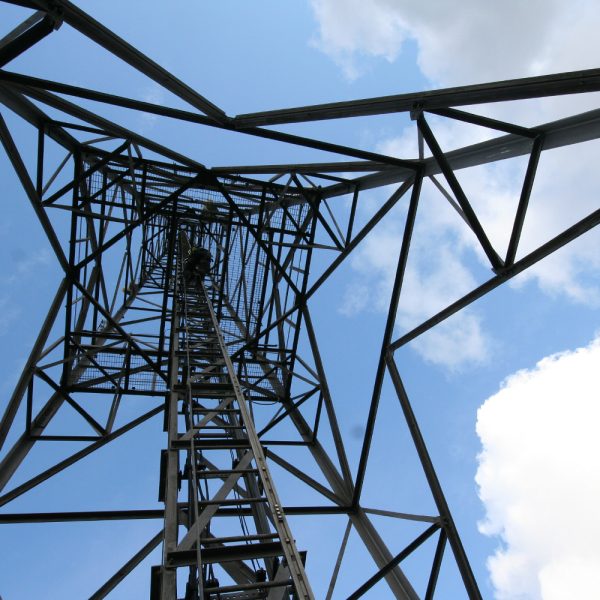
Common during breeding season, typically from February to August in the UK, nesting birds can create significant operational and legal challenges for organisations carrying out work at height. To address these risks, the Mast and Tower Safety (MATS) Group, in collaboration with the RSPB, has published guidance for managing nesting birds on telecoms masts, towers and rooftops.
Under the Wildlife and Countryside Act 1981, and the Wildlife Order 1985 in Northern Ireland, killing, maiming, or taking any wild bird, including damaging eggs or nests, is an offence. ‘Schedule 1 Protected Birds’, such as Peregrine Falcons and Barn Owls, have additional legal protection, beyond that given to all wild birds. By complying with regulations that protect birds, organisations can help support biodiversity and help maintain positive relationships with authorities and local communities.
Site Staff Responsibilities
Effective management of nesting birds depends on clear responsibilities between site visitors, site owners and subject matter experts. For example, site visitors must plan for a bird encounter before attending site—this requires integrating nesting birds into the site risk assessment. If a nesting bird is discovered on site, work must be halted and the site owner must be informed.
Responsibility then falls to the site owner, who must regulate the site by implementing restrictions in line with legislation. The site owner must record cases of nesting birds. This documentation can then be used for future site visitor risk assessments.
Additionally, subject matter experts (SMEs) are crucial for assessing evidence of nesting birds and evaluating the level of disturbance. The site owner and site visitors must be informed of the estimated output. The results of the SME’s evaluation will determine what present, and future activity, can take place.
Planning and Procedure
Workers must be aware of nesting bird procedure, and it is essential that structures are evaluated before any work commences. Nesting birds must be included in site risk assessments. For high-risk areas, projects can be scheduled outside the breeding season to reduce the likelihood of disruption.
 Identification
Work must be stopped immediately if a nesting bird is located on-site during active work. Nesting information, which will inform the site evaluation, must be recorded. Details include the observation date, bird species, whether parent birds are nearby, whether birds are occupying the nest, and whether young chicks are present. Young birds are particularly vulnerable during incubation stages and early hatching stages.
Drones are permitted for this data collection. However, they require their own risk assessment (which must consider factors such as collision risk).
Site Assessment
A site assessment helps determine how long nesting activity is likely to continue and when work may safely resume. Structure height, regional site location, and the presence (and consequent threat) of defensive birds such as gulls, are all factors that must be considered. In all cases, a site-specific assessment must occur. The guidance from MATS Group includes a report appendix, which can be used to document nest details like these.
Output
Assessment outcomes include work suspension, work to continue using a ‘spotter’, or work continuing as normal. Alternatively, if the nesting stage is unknown, the site owner must restrict access for 12 weeks.
Once an active nest has been identified, future site access must be managed and internal incident reports must be implemented into future planning. In emergency scenarios, an exemption to proceed with planned work (known as a disturbance license) can be obtained. For this to be granted, work must be deemed essential for public safety, and bird species must be identified.
It should be noted that nests are no longer considered live once chicks have fledged and the nest is no longer used. Temporary access restrictions can thus be removed from redundant nests. This, however, does not apply to Golden Eagle, White Tailed Eagle or Osprey nests. These cannot be removed due to additional legal protection.
Early identification, careful planning and site-specific assessments are key to balancing operational requirements with legal and environmental responsibilities. It is crucial that organisations understand nesting legislation, alongside the correct procedures.
To read the complete MATS / RSPB Nesting Bird Guidance document, click here.
